Types of Forward Contract: Fixed, Open and Window
By Harry Mills, Managing Director, Oku Markets · Updated
There are three main types of FX forward contract: fixed, open and window. All three lock in an amount and an exchange rate for a future date. A fixed forward settles on one date only, an open forward can be used at any time up to maturity, and a window forward can be used within a set period before maturity.
Key points
- Every forward contract has a set amount, rate and future maturity date.
- Fixed: settlement on one future date only.
- Open: fully flexible – settle at any time up to the maturity date.
- Window: settle at any time within a window of dates up to maturity.
- More flexibility can come at a price, because the forward rate depends on the length of the contract and the interest rate differential between the two currencies.
5-minute read
If you’re new to forwards, start with our introduction to FX forward contracts – this article picks up where that one leaves off.
The Basics
A forward contract is an agreement to buy or sell one currency for another at an agreed rate and at an agreed future date.
Forward contracts allow you to secure exchange rates for future exposures and minimise the impact of currency fluctuations and market volatility.
The exchange rate on a forward is typically higher or lower than the spot rate – this is due to the interest rates of the two currencies involved. Read more in our introduction to FX forward contracts, or feel free to call, DM, or email us with any questions.
Forwards are favoured by treasurers and FDs/CFOs for their simplicity, availability, flexibility, and the certainty they provide.
The Benefits of Forward Contracts
Unlike most FX firms, we take a truly client-first approach and we believe that the decision to hedge or not is unique to each business. If currency hedging is appropriate and would help a business to reduce risk and achieve its objectives, then forward contracts will likely play an important role in the strategy.
- Certainty – Guarantee the exchange rate for future payments or receipts
- Predictability – Securing future conversion rates makes cash flows predictable
- Flexibility – Some contracts can be used at any time before the maturity date
- Simplicity – Trade quickly online, in any size, and in most currencies
Types of Forward Contract
The basics apply to all contracts – a set amount, rate, and future maturity date – but there are three main types of contract to be aware of:
- Fixed: Settlement is restricted to one future date only
- Open: Fully flexible, allowing settlement at any time up to the maturity date
- Window: Can be utilised within a window of time up to the maturity date
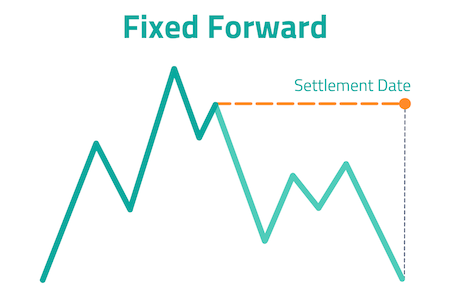
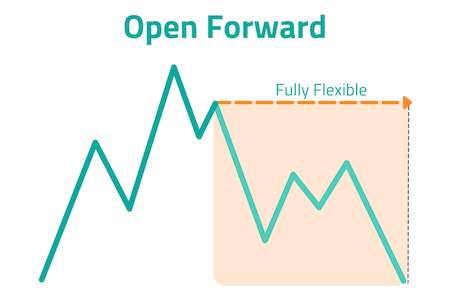
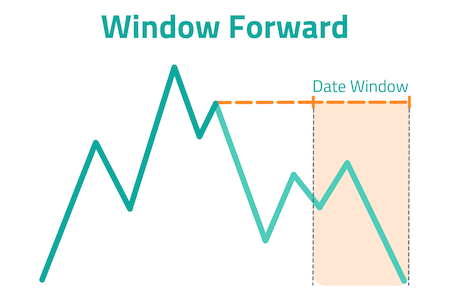
The open forward gives the most flexibility for drawdowns and utilisation, but it can come at a price. The reason we provide the three types of contract is that the forward rate is influenced heavily by the length of the contract and the size and sign (positive or negative) of the interest rate differential of the two currencies involved.
A quick example (illustrative rates):
- An Irish company imports from China in USD (so they sell EUR to buy USD)
- They have an invoice of $500K to pay in 6 months’ time
- The spot rate is EUR/USD 1.0000, and the 6m swap points are +0.0120
- Open Forward exchange rate is quoted at 1.0000, $500K costs €500,000
- Fixed Forward exchange rate is quoted at 1.0120, $500K costs €494,071
Because the open forward could be used on any day from now until maturity, it’s priced at the least favourable rate across that period – here, the spot rate. The fixed forward gets the full benefit of the swap points, so in this example the certainty of a single date is worth €5,929.
Flexibility matters most when your dates might move. If a project slips, you can end up holding currency you don’t need yet – our guide to over- and under-hedging covers what to watch for. And if a fixed forward’s date does need to change, it can be rolled forward or brought in with an FX swap.
If in doubt, you should speak to your FX dealer about forward pricing and which solution would be best for your needs, balancing flexibility and market pricing.
Forward with Oku Markets
Oku Markets provides live forward contract trading to clients online and via our telephone dealing desk. We always give our customers fixed, consistent, fair, and transparent FX prices, so you can trust us to work with you, not against you!
Find out more about how we help with currency risk management, or contact us at info@okumarkets.com or 0203 838 0250 to discuss your needs!
Frequently Asked Questions
What are the different types of forward contract?
There are three main types: fixed, open and window. All have a set amount, rate and future maturity date. They differ in when you can settle: on one date only (fixed), at any time up to maturity (open), or within a window of dates up to maturity (window).
What is a fixed forward contract?
A fixed forward settles on one agreed future date only. It’s the least flexible type, but it usually gets the full benefit (or cost) of the swap points, so the rate reflects exactly the period you’ve chosen.
What is an open forward contract?
An open forward is fully flexible. You can settle at any time from the trade date up to the maturity date, which suits businesses whose payment dates aren’t certain.
What is a window forward contract?
A window forward can be used at any time within a set window of dates up to the maturity date. It sits between fixed and open: more flexible than a single date, usually cheaper than full flexibility.
Why can an open forward cost more than a fixed forward?
The forward rate depends on the length of the contract and the interest rate differential between the two currencies. Because an open forward could be settled on any day up to maturity, it’s priced at the least favourable rate across that period. In our illustrative example, that meant €500,000 for $500K on an open forward, against €494,071 on a fixed forward.
Which type of forward contract should my business use?
It depends how sure you are of your payment or receipt dates, and how much you’re willing to pay for flexibility. If the date is firm, a fixed forward is usually best value. If it could move, a window or open forward may be worth the difference. Ask your FX dealer to price each type side by side.
Can I change the date of a forward contract?
Yes. A forward can usually be rolled forward to a later date or brought in to an earlier one using an FX swap. There may be a cost or a benefit from the interest rate differential, and a near-leg loss may need funding with cash – our FX swap guide explains how it works.
Do I have to use an open or window forward all at once?
Not necessarily. Open and window forwards are designed for flexible drawdowns, so you can usually use the currency in parts within the agreed period, as long as the full amount is used by the maturity date. Check the terms with your provider.
Get Weekly Outlook — one clear FX read a week.
Subscribe