What is an FX Swap?
By Harry Mills, Managing Director, Oku Markets · Updated
An FX swap is the simultaneous purchase and sale of one currency for another across two different settlement dates – usually a spot trade (the near leg) and a forward in the opposite direction (the far leg). Businesses use swaps to cover short-term cash gaps, and to roll forward or bring in a forward contract.
Key points
- An FX swap has two legs: you sell currency A to buy currency B on one date, then reverse it on a later date.
- One side is usually a fixed amount – the other differs because the spot and forward rates differ.
- Businesses use swaps to manage cash imbalances between dates, and to roll forward or pre-deliver a forward contract.
- Rolling a forward can create a near-leg loss that needs cash now, plus a cost or benefit from the interest rate differential.
- “Free” rollovers and cancellations usually aren’t – ask for the workings and check them.
5-minute read
If you’ve not yet read our introduction to FX forward contracts, you can find it here. In this article we’ll explore FX Swaps, what they are, and why you might use them!
Note: there are several flavours of swaps, so it’s good practice to be attentive and specify “FX Swap”, but for the sake of this article we’ll now just use “swap”…
I’ll swap you…
Let’s start with the basics: a Spot trade involves selling one currency to buy another for immediate settlement, a Forward trade is the same, but the settlement is some future date, a Swap involves two “legs”, usually a Spot and a Forward, looking something like this:
- Near Leg: Sell CCY A to buy CCY B (Spot Date)
- Far Leg: Sell CCY B to buy CCY A (Forward Date)
An FX Swap is therefore the simultaneous purchase and sale of one currency for another across two different settlement dates.
💡 Swaps are the most traded FX instrument, equating to about 42% of daily volume in the market (BIS Triennial Survey, April 2025).
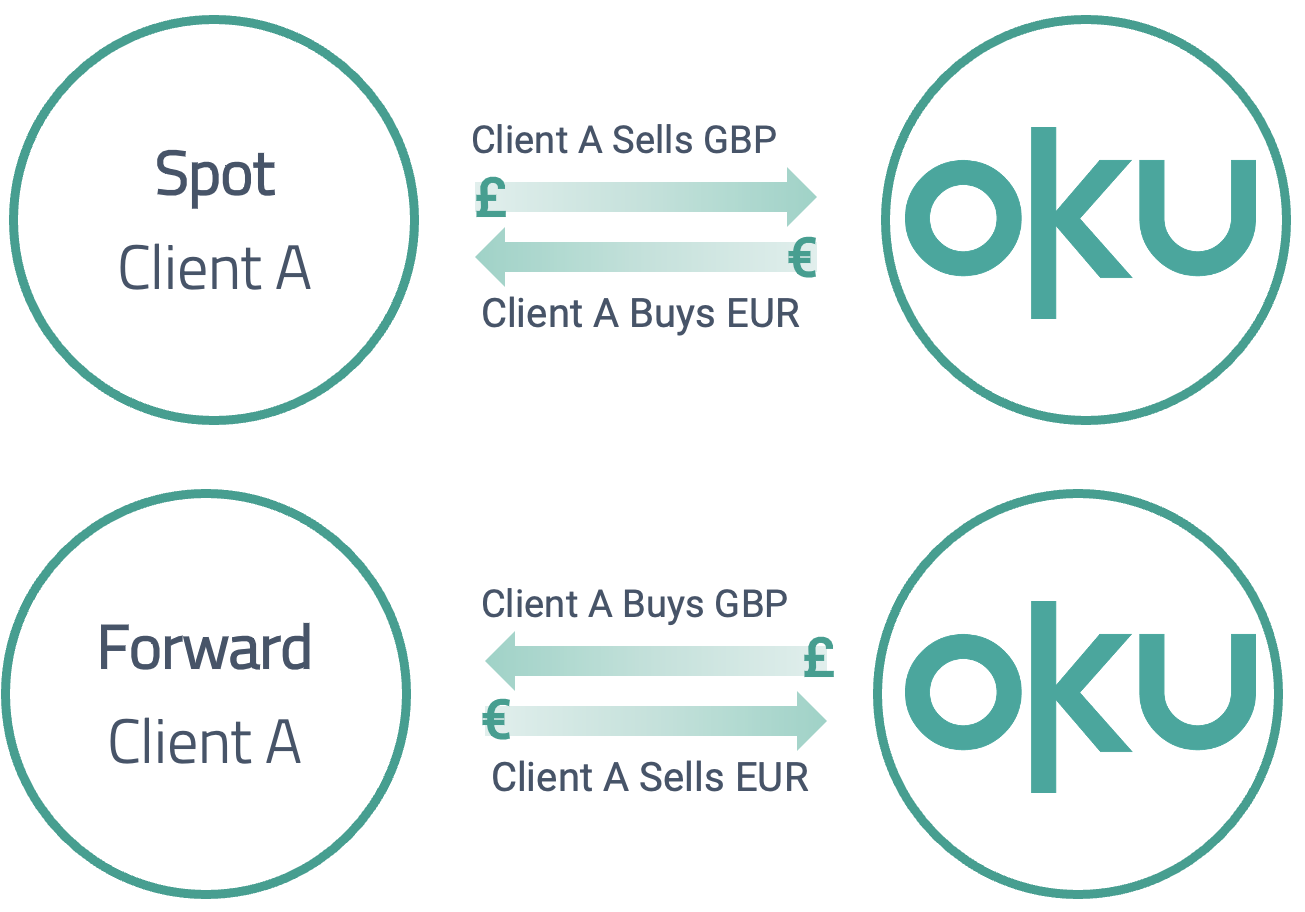
In almost all cases one side of the trade is for a fixed amount, for example selling £1million to buy USD spot as the near leg, then later selling USD to buy back £1million for the far leg. In this example, only the USD amounts would differ due to different spot and forward rates.
It’s possible to execute an uneven (or mismatched) swap where the amounts on each leg aren’t the same.
The near leg of the swap doesn’t have to be the Spot date, it could be any date in the future that’s before the Far date. This type of swap is called a forward-forward.
Why use a Swap?
Swaps are the go-to tool for corporate treasurers as they allow for cash imbalances between dates to be managed effectively. Imagine that ABC Corp is holding $5m, has payables of $8m in two weeks, and is due to receive $5m in four weeks. Clearly, there’s a $3m gap to be funded in two weeks. They could execute a swap to buy $3m for two weeks and sell $3m in four weeks, leaving their net position as +$2m in four weeks: their receipt of $5m will offset their $3m sell obligation from the far leg of the swap.
Swaps can also be used to bring in (pre-deliver) or roll forward a Forward Contract settlement date. Let’s look at an example:
- ABC Corp has a Forward Contract to sell GBP and buy EUR 1million in 6 months
- Their project is delayed, meaning they now need the euros after 9 months, not 6
- They enter a Swap to sell EUR 1m in 6 months and to buy EUR 1m in 9 months
Delays like this are one way a business ends up over-hedged for a while – our guide to over- and under-hedging covers what to watch for.
In the example above, there will be two cash flow considerations:
- The original forward rate will very likely be different to the rate of the near leg on the swap. This will create a profit or loss in GBP that will be offset upon settlement of the far leg of the swap. Near-leg losses, while offset later, do require funding with cash – this happens when the close-out rate (the swap near-leg in this instance) is in the money (more favourable) compared to the original rate.
- The rate for the far leg of the swap will be different to that of the near leg due to the interest rate differential (read the article linked at the start for why). This means there may be a cost or a benefit to rolling forward this trade.
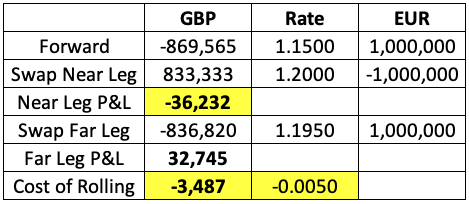
In the table (illustrative rates, not live market prices), the original forward buys €1m at 1.1500 for £869,565. Selling the €1m back on the near leg at 1.2000 brings in £833,333 – a near-leg loss of £36,232 that needs paying in cash at six months. The far leg buys the €1m again at 1.1950 for £836,820, which is £32,745 less than the original forward, so the net cost of rolling is £3,487.
Don’t trip up
At Oku Markets we believe in educating and empowering our clients by being fully transparent and honest with how markets operate and our FX pricing. It’s very common for FX brokers to widen spreads and exaggerate the impact of swap points on forward rollovers, unwinds, and early deliveries. Here’s two tips:
- There’s usually no such thing as “free” when it comes to unwinding (cancelling) a trade or taking early delivery or rolling forward. It doesn’t hurt to ask for the details and call back later once you’ve checked it out. I say “usually” because sometimes the price difference is so small (sometimes a loss) that the broker will just wear a small loss for convenience/to do you a favour. But more often than not, “free” means there’s a profit that you’re not seeing!
- If there is a cost to you then it’s very likely that there will be a mark-up applied to the bank/broker’s costs. This is fine, and it’s absolutely fair and normal practice to charge a little for work, but sometimes these costs are inflated to maximise income on what is usually a very straightforward transaction. Rollovers and cancellations can be big money-makers, so if the cost sounds a little high then ask for the workings out and check them independently.
Want to know more?
Our philosophy at Oku Markets means no smoke and mirrors, and complete transparency with pricing and how markets operate.
You can find out more about how we approach hedging on our risk management page, or contact us for a review of your currency processes and for our guidance and suggestions at info@okumarkets.com or 0203 838 0250.
Frequently Asked Questions
What is an FX swap?
An FX swap is the simultaneous purchase and sale of one currency for another across two different settlement dates. It usually combines a spot trade (the near leg) with a forward trade in the opposite direction (the far leg).
What is the difference between an FX swap and an FX forward?
An FX forward is a single trade in one direction for settlement on a future date. An FX swap combines two trades, usually a spot and a forward, with the far leg reversing the currency cash flows of the near leg.
What are the near leg and the far leg of a swap?
The near leg is the first settlement – for example, selling GBP to buy USD on the spot date. The far leg is the later settlement, where the trade is reversed – selling the USD to buy back the GBP on the forward date.
Does the near leg have to settle on the spot date?
No. The near leg can be any date before the far date. A swap where both legs are in the future is called a forward-forward.
Why do businesses use FX swaps?
To manage cash imbalances between dates – for example, covering a short-term shortfall in one currency until a receipt arrives – and to bring in (pre-deliver) or roll forward the settlement date of an existing forward contract.
How do I extend a forward contract with a swap?
You enter a swap where the near leg reverses the original forward on its settlement date and the far leg puts the same trade back on at the new, later date. For a forward to buy EUR 1m in six months, delayed to nine months, that means selling EUR 1m in six months and buying EUR 1m in nine months.
Does rolling a forward contract cost money?
It can. The far-leg rate differs from the near-leg rate because of the interest rate differential between the two currencies, so there may be a cost or a benefit to rolling. If the market has moved in your favour since you booked the original forward, the near leg also creates a loss that has to be funded with cash, even though it’s offset when the far leg settles.
Is a free rollover or cancellation really free?
Usually not. Sometimes the price difference is so small that a broker will absorb it, but more often than not “free” means there’s a profit you’re not seeing. Ask for the workings out and check them independently.
Is an FX swap the same as a currency swap?
Not quite. There are several flavours of swap, which is why it’s good practice to say “FX swap”. A cross-currency swap is a separate, usually longer-term instrument that also exchanges interest payments between the two parties.
Thanks for reading 👋